Introduction: Why Hiring Needed a Smarter System
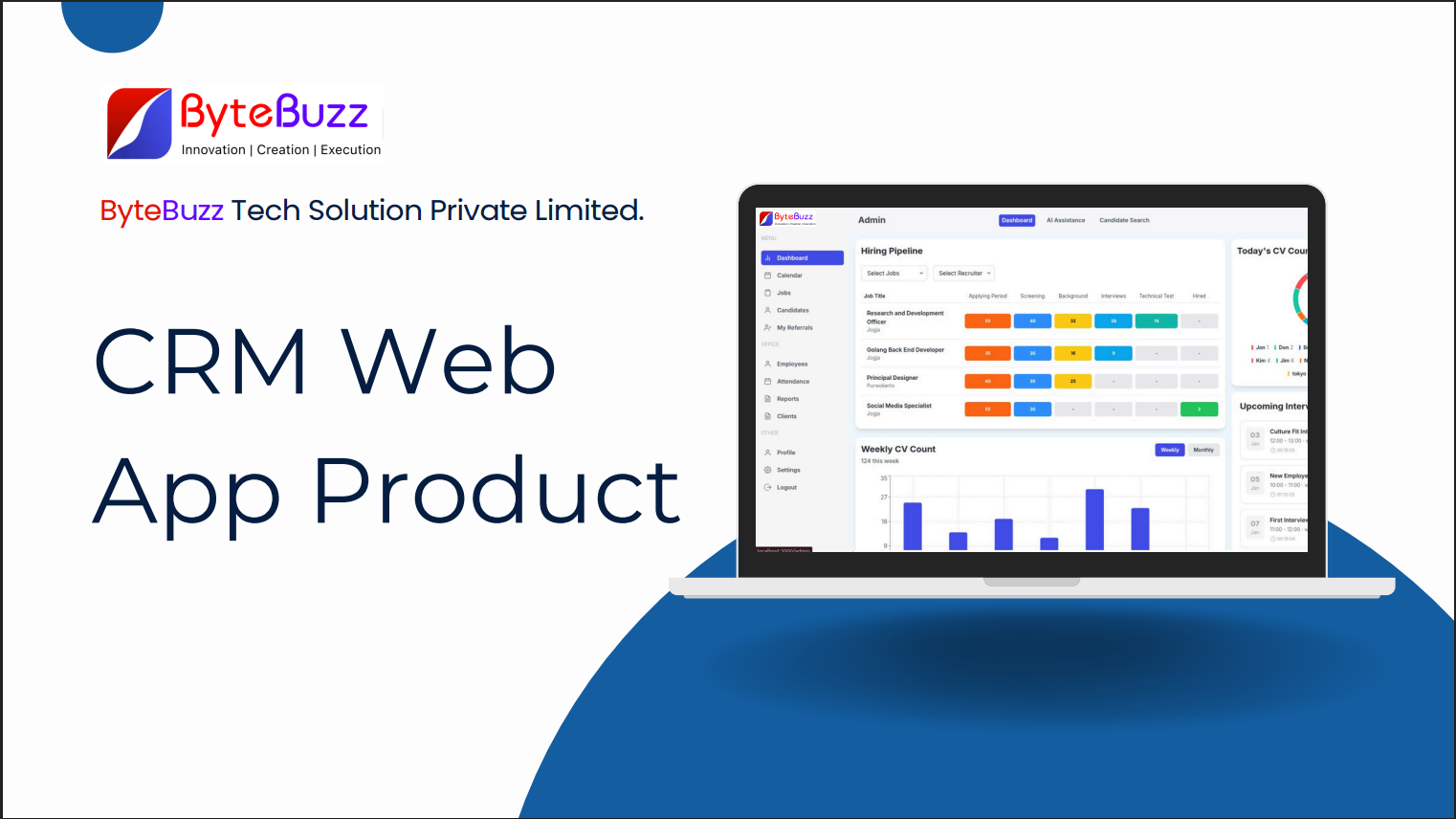
Recruitment and human resource management have always been time-intensive, data-heavy processes. Companies spend weeks screening candidates, managing pipelines, and coordinating interviews — often losing qualified talent to slow processes and scattered tools. ByteBuzz Tech Solution Private Limited recognized this problem and built something to fix it from the ground up.
The ByteBuzz HRMS and CRM Web App is an integrated, AI-powered platform designed to bring the entire recruitment lifecycle and HR workflow into a single, intelligent system. From a candidate's first application to their onboarding, every step is streamlined, tracked, and optimized.
What Is the ByteBuzz HRMS & CRM?
At its core, the ByteBuzz platform is two systems working as one:
The Candidate Portal — A public-facing dashboard that allows job seekers to create profiles, apply to jobs, track their application status, and manage their career presence on the platform.
The Internal CRM and ATS — A powerful back-end system built for recruiters, employees, and administrators to manage hiring pipelines, post jobs, evaluate candidates, schedule interviews, track attendance, generate reports, and leverage AI-powered candidate search.
Together, these two systems eliminate the need for multiple disconnected tools and create a single source of truth for recruitment data.
Phase 1: Building the Foundation
Candidate Profile Builder — CV parsing auto-fills all fields
Candidate Dashboard — track applied jobs, saved roles & recommendations
01 — ByteBuzz Website with Candidate Dashboard
The first major component of the platform is the candidate-facing experience. ByteBuzz built a clean, intuitive portal that allows job seekers to become active participants in the hiring process rather than passive applicants.
Profile Creation with CV Parsing
Candidates begin by creating their professional profile. The platform includes a CV upload feature that automatically parses the resume and fills in profile fields — name, email, skills, experience, education, and more. This removes friction from the sign-up process and ensures profiles are rich with data from day one. Candidates can then review, verify, and update any auto-filled information before saving.
Personalized Candidate Dashboard
Every candidate receives their own personalized dashboard. The dashboard gives a clear, real-time overview of:
This centralized space means candidates never have to guess where they stand. They can track every application, manage saved roles, and stay informed throughout their entire job search journey without switching between tools.
Apply to Active Jobs
Candidates can browse and apply to active job postings directly through the platform. Each listing shows the job title, location, experience required, skills needed, employment type, and client. Applications are submitted using the candidate's existing profile, making the process fast and seamless. The system also supports Onsite, Hybrid, and Remote filters so candidates can narrow down roles that match their work preferences.
Save Jobs for Later
Candidates can bookmark roles they are interested in by saving them to their dashboard. Saved jobs are visible alongside applied jobs, allowing candidates to revisit opportunities, compare listings, and apply at a time that suits them.
Profile Settings and Management
Candidates have full control over their profile at all times. The settings panel is divided into three tabs — My Details, Profile, and Work Experience. From here, candidates can update their name, email, photo, role, country, and bio. They can also manage their work history and professional information to ensure their profile always reflects their most current experience.
02 — CRM and ATS for Internal Employees
The second and most powerful component of Phase 1 is the internal CRM and ATS built for ByteBuzz employees and recruiters. This system gives every team member a dedicated workspace to manage jobs, candidates, schedules, and HR operations.
Personalized Employee Dashboard
Every employee receives a personalized dashboard tailored to their role and responsibilities. The dashboard is designed for high information density without clutter. Key elements include:
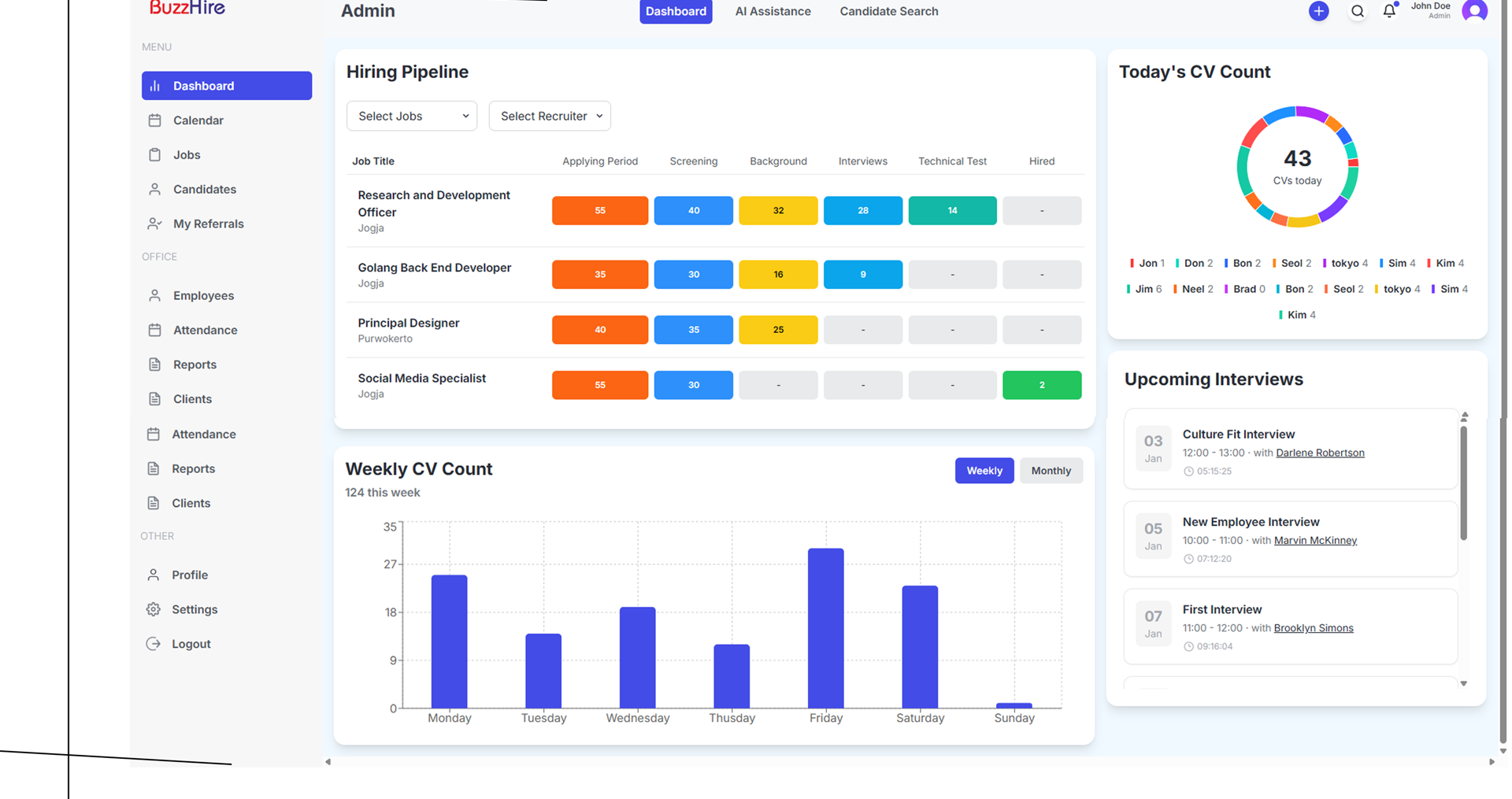
The Hiring Pipeline — a live table showing active job roles, recruiters assigned, and candidate counts at each stage of the process: Applying Period, Screening, Background Check, Interviews, Technical Test, and Hired.
Today's CV Count — a real-time donut chart showing how many CVs have been received today, broken down by recruiter.
Weekly CV Count — a bar chart displaying CV volume over the past week or month, giving recruiters a visual understanding of application trends.
Upcoming Interviews — a live sidebar showing scheduled interviews with candidate names, times, and meeting details.
This dashboard gives every recruiter, admin, and team lead exactly the data they need to make quick, informed decisions without navigating through multiple screens.
Employee Calendar
Every employee has access to a fully functional calendar system. The calendar supports weekly, daily, monthly, and agenda views. Interview schedules are displayed directly on the calendar, showing the candidate name, time slot, and interviewer. The calendar helps teams coordinate availability, avoid scheduling conflicts, and maintain a structured interview process across the organization.
Jobs Management — Active and Inactive Listings
The Jobs section gives recruiters complete control over job postings. All active and inactive jobs are displayed as cards, each showing the client name, job title, total candidates, new applications, location, employment type, and publication status. Recruiters can filter jobs by type and sort them by various criteria. Clicking into a job opens the full candidate pipeline for that role.
Each job listing has four sub-sections:
Candidate Management
The Candidates section aggregates all applicants across all jobs. Recruiters can view the complete candidate list with names and application IDs. Each candidate entry opens a detailed side panel containing four tabs:
Details — Basic and professional information including name, email, phone, location, sourced-by recruiter, candidate ID, applied date, current job title, highest qualification, expected salary, current salary, years of experience, and skill tags.
Resume — The full candidate resume, directly embedded and viewable without downloading.
Hiring Pipeline — A visual representation of where the candidate stands in the hiring process with stage-by-stage history.
Interviews — A complete log of all scheduled and completed interviews for that candidate.
Candidates are only visible to the recruiter whose application link was used. This ensures clean data ownership and prevents cross-recruiter confusion.
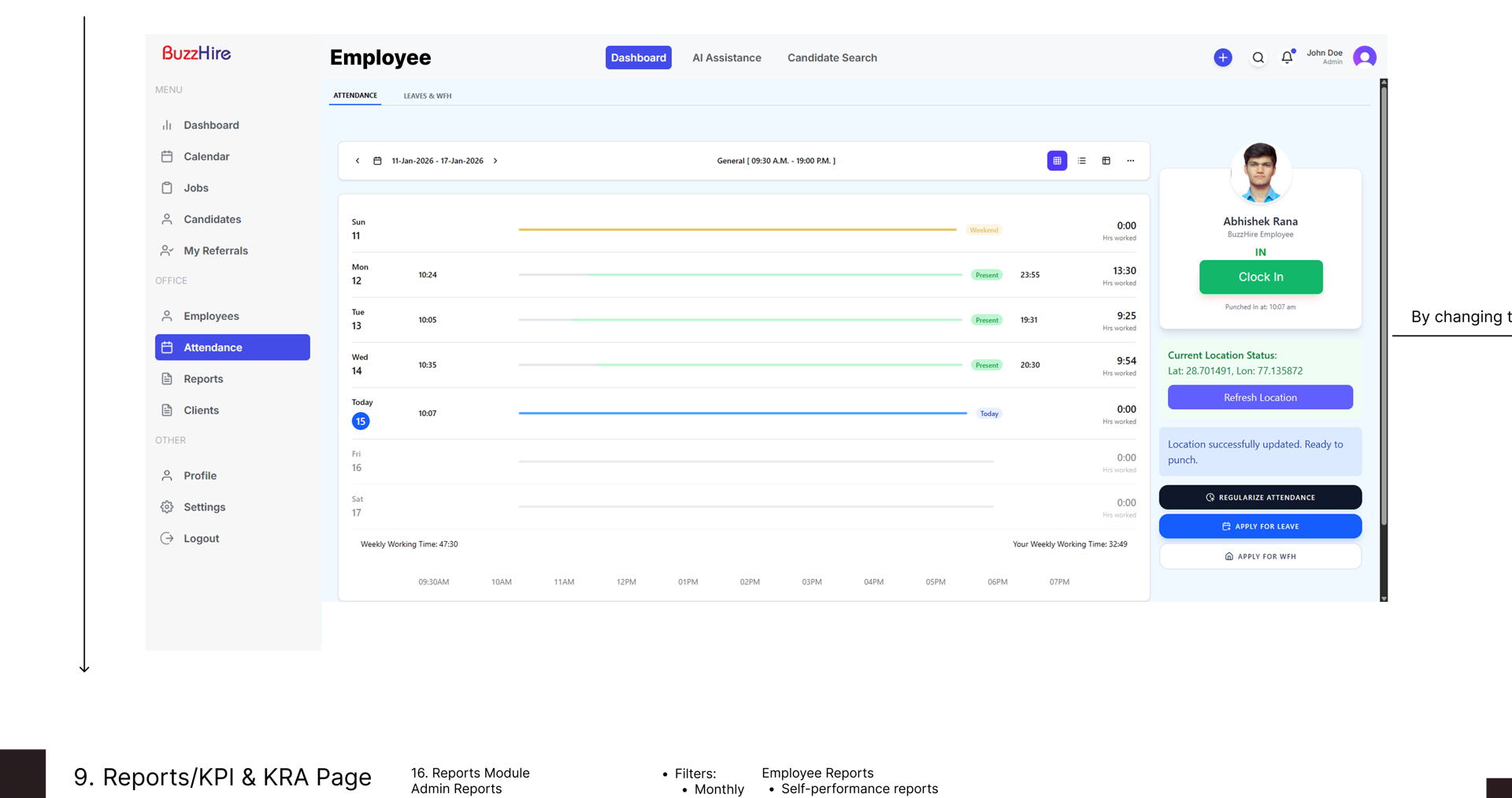
Attendance Management with Geo-Location Punch-In
The attendance module is a standout feature of the HRMS. Employees mark their daily attendance using a geo-location-based punch-in system. Each employee's attendance page shows their shift details, current in/out status, hours worked, and leaves taken. A Punch In button initiates the geo-location verification and records the attendance timestamp.
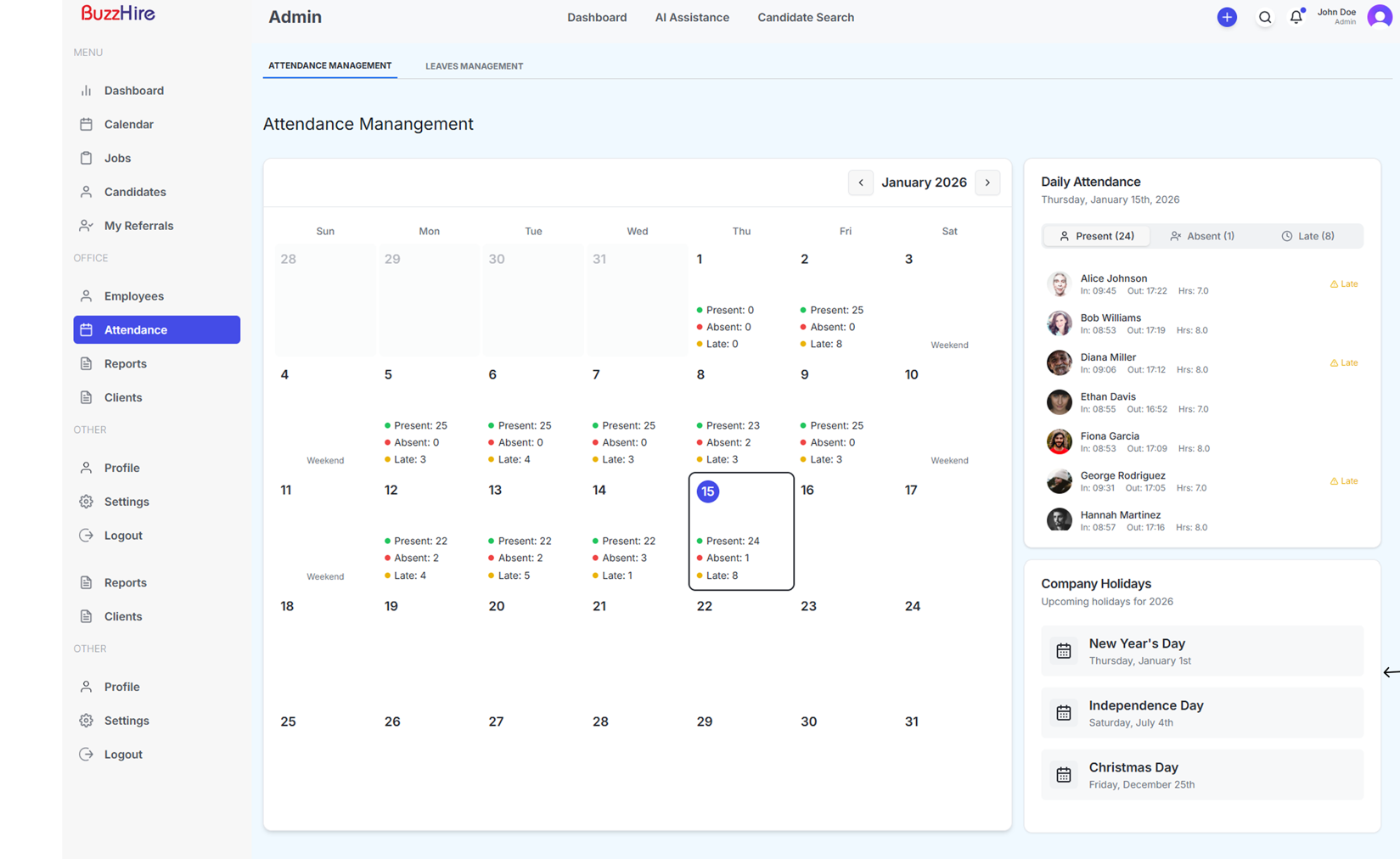
For administrators, the Attendance Management panel shows a consolidated calendar view of the entire organization. Each calendar date displays the number of present employees, absent employees, and late arrivals. The right panel shows a Daily Attendance breakdown with individual employee check-in times, check-out times, and total hours worked. Company holidays are also listed for planning purposes.
The system also supports a Leaves Management section, a Shift configuration module, and a Separation workflow for offboarding employees.
Advanced AI-Powered Candidate Search
One of the most powerful features of the internal CRM is the AI Assistance and Candidate Search capability. By integrating with leading AI APIs — including OpenAI, Gemini, and Claude — the platform provides intelligent search that goes far beyond keyword matching.
Recruiters can describe a role or paste a job description, and the AI will access the candidate database and automatically shortlist profiles based on:
This dramatically reduces the time recruiters spend manually screening CVs and ensures that top candidates are surfaced quickly and accurately.
Reports and Client Management
The Reports module allows recruiters to generate detailed reports at both individual and group levels. Individual candidate reports include their full profile, application history, pipeline status, and interview feedback. Group reports can be organized by client, job role, or date range, giving management a high-level view of hiring activity and recruiter performance.
The Clients section maintains a database of client companies, their active jobs, and historical hiring data. Recruiters can also draft and send client-specific emails directly from within the platform, keeping all communication centralized and traceable.
Phase 2: BETA Testing and AI Integration
Internal CRM Dashboard — hiring pipeline, CV count & upcoming interviews
Phase 2 marks the transition from internal use to external validation. The CRM is released as a free BETA product to HR firms, recruitment agencies, and businesses who want to modernize their hiring operations.
During this phase, every company that uses the platform contributes to a growing data pool. Candidate profiles, job descriptions, recruiter decisions, and hiring outcomes are all securely stored on ByteBuzz servers. This data becomes the foundation for the AI and ML training that powers Phase 3.
The AI search functionality is further refined during BETA. Results are continuously optimized based on real-world feedback — improving the accuracy of candidate-to-job matching and refining the shortlisting logic.
A referral system is also introduced during Phase 2, allowing employees and clients to refer candidates and track referral outcomes. The end of Phase 2 signals the platform's readiness for a full commercial market launch.
Phase 3: AI and Machine Learning Research and Development
Phase 3 is the most transformative stage of the ByteBuzz platform roadmap. This is where the system evolves from a smart recruitment tool into a truly intelligent hiring engine.
Core Focus
The AI and ML layer is built on top of all the data collected across Phases 1 and 2 — candidate profiles, recruiter decisions, hiring outcomes, interview results, and rejection patterns. The models are trained to understand how recruitment actually works, not just how it is theoretically described.
Recruiter Behavior Modeling
The AI learns how individual recruiters and teams think by studying their historical decisions. It analyzes patterns such as which types of profiles get shortlisted for which roles, which candidates get rejected and why, what experience levels and skill combinations lead to hires, and which profiles perform well after joining. Over time, this creates a recruiter behavior model that can predict which candidates a particular recruiter is likely to approve before any human review takes place.
Candidate Evaluation
Beyond recruiter preferences, the AI evaluates candidates on their own merits. It assesses project complexity and relevance, years and quality of experience, employer history and brand weight, educational background, and skill alignment with specific job descriptions. Each candidate receives an intelligent match score for every applicable job in the system.
Learning Process
The model continuously identifies trends in profiles being forwarded versus rejected. It factors in experience level, project history, employers, education, and domain specialization to build a dynamic scoring system that improves with every decision made on the platform.
AI Sourcing
The final capability in Phase 3 is autonomous candidate sourcing. After sufficient training, the AI can proactively identify and surface high-fit candidate profiles from the database — before a recruiter has even started searching. This means open roles can begin attracting pre-qualified candidates the moment they are posted, reducing time-to-hire significantly.
Product Timeline
The ByteBuzz HRMS and CRM roadmap spans eight months from initial build to full AI launch:
Phase 1 — August, September, and October (3 months): Complete platform development including candidate dashboard, CRM, ATS, and all core features.
Phase 2 — November and December (2 months): BETA release, AI search integration, user data collection, referral system launch, and market preparation.
Phase 3 — January, February, and March (3 months): Full AI and ML model development and deployment. Note that while building the AI model takes approximately three months, training it to reach production-ready accuracy can take between six months and one year depending on data volume and model complexity.
Why ByteBuzz Built This
ByteBuzz began with a simple question: Can technology work better?
The HRMS and CRM platform is the answer to that question applied directly to the hiring industry. Recruitment is still largely manual, fragmented, and slow. Companies use spreadsheets to track candidates, email chains to coordinate interviews, and guesswork to evaluate fit.
ByteBuzz replaces all of that with a single intelligent platform — one that learns, adapts, and continuously improves with every hire made. The goal is not just to digitize recruitment but to fundamentally reimagine it.
The platform is built on ByteBuzz's core principles: AI-led engineering, long-term technology partnerships, clean design, robust infrastructure, and data-driven decision-making. Every feature was designed with one outcome in mind — helping companies build better teams, faster.
Whether you are a startup posting your first five roles or an enterprise managing hundreds of concurrent hiring pipelines, the ByteBuzz HRMS and CRM scales with you, learns from you, and works harder the longer you use it.